




 Skip to main content
Area: 19.13 km²
Population: 709
Altitude: 603m a.s.l.
Geographic coordinates: 39°42′5.29″N 9°8′44.96″E
Patron Saint: Saint Basil the Great
Surrounded by lush and unspoilt vegetation of centuries-old woodland in the heart of Sardinia, the Giara di Serri offers a natural landscape dominated by the majestic cork oak, holm oak, downy oak and cistus. On this plateau of volcanic origin, the eye loses itself in a breathtaking panorama embracing the mighty Gennargentu massif and the gentle hills of the Marmilla in a matchless setting, especially at sunset: the colours that paint the sky at dusk add a magical touch to an already spectacular view. The Giara di Serri is an ideal place for exciting excursions or for observing and photographing the great variety of bird species that inhabit it. Those wishing to keep fit in contact with nature can use the fitness trail set up in the evocative Su Monti Comunu woodland area.
The Santa Vittoria Nuragic Sanctuary, one of the most important cultic complexes of Nuragic Sardinia, extends over approximately 22 hectares on the edge of the Giara di Serri. The site may have been in use from as early as the first phase of Nuragic civilisation, and ongoing excavations continue to yield interesting traces of the past.
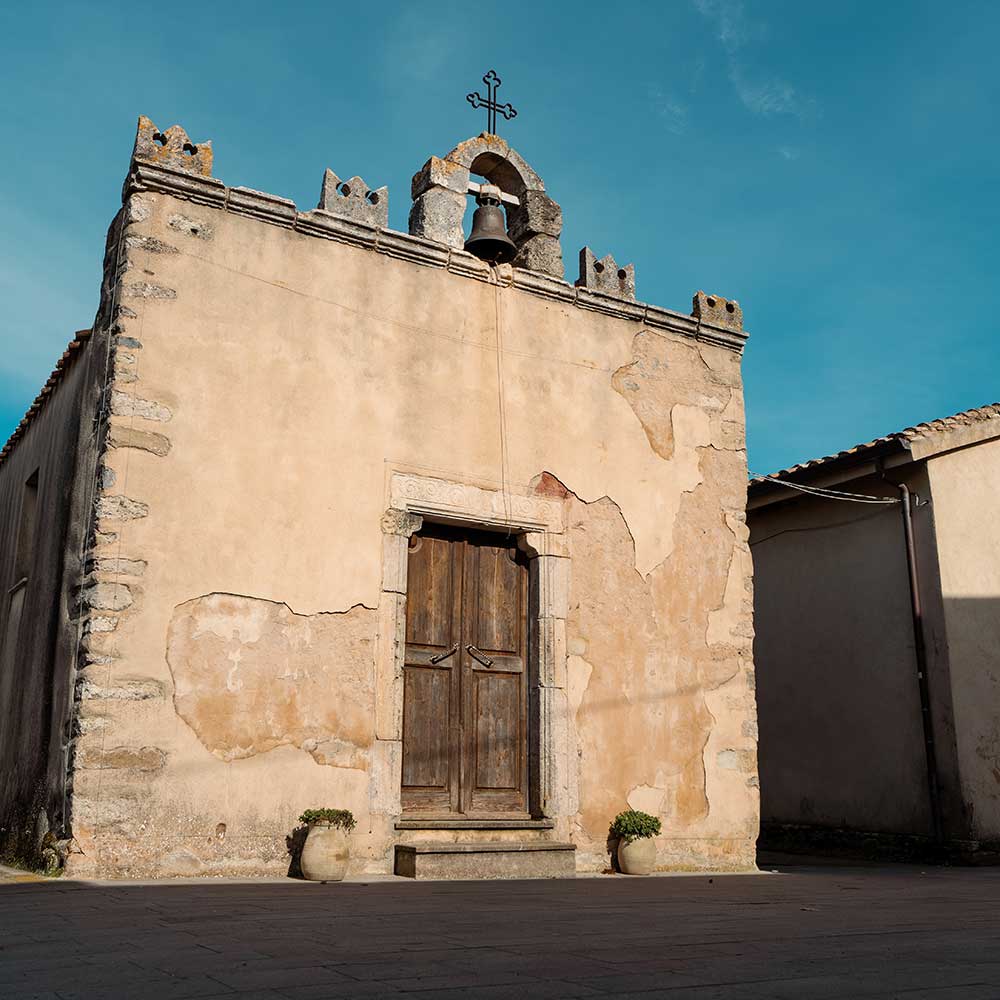
The village, where ancient rural houses with arched doorways and spacious courtyards can be admired, is adorned with murals that recount the history, culture and traditions of Serri. One of these depicts the small church of Sant’Antonio Abate, where the annual feast with the traditional bonfire takes place. The parish church of Serri is dedicated to Saint Basil the Great: built in 1100 in the Romanesque-Pisan style, its interior houses an eighteenth-century marble high altar and three wooden altars in the Baroque style.
Serri boasts a strong historical and cultural identity, also expressed through its traditional products and recipes. The typical pasta shape is pitzottis serresus, made from a dough of water and flour, hand-crafted one by one with skilled gestures passed down from generation to generation. The table is never without delicious cheeses and cured meats, the finest expression of the pastoral activity on which the local economy is based.
Among the most characteristic local festivities is the Santa Lucia fair, enlivened by shows and exhibitions on the third Sunday of May and September. Established in the early twentieth century as a livestock fair, by the 1950s it was one of the most important fairs in Sardinia. Today the Santa Lucia fair is a showcase for the promotion of zero-kilometre local products, with the added attraction of live animals.
One of the most important cult complexes of Nuragic Sardinia, frequented from the Early Bronze Age to the Middle Ages
In a natural setting with rivers and woods, a place of carefree tranquility where centuries-old traditions of artisanal production are handed down.
GONI
Surrounded by lakeside landscapes, a museum-town that houses archaeological treasures and characteristic courtyard houses built from local basalt blocks.
ORROLI